Search
Viewing 1 to 15 of 113 news
-
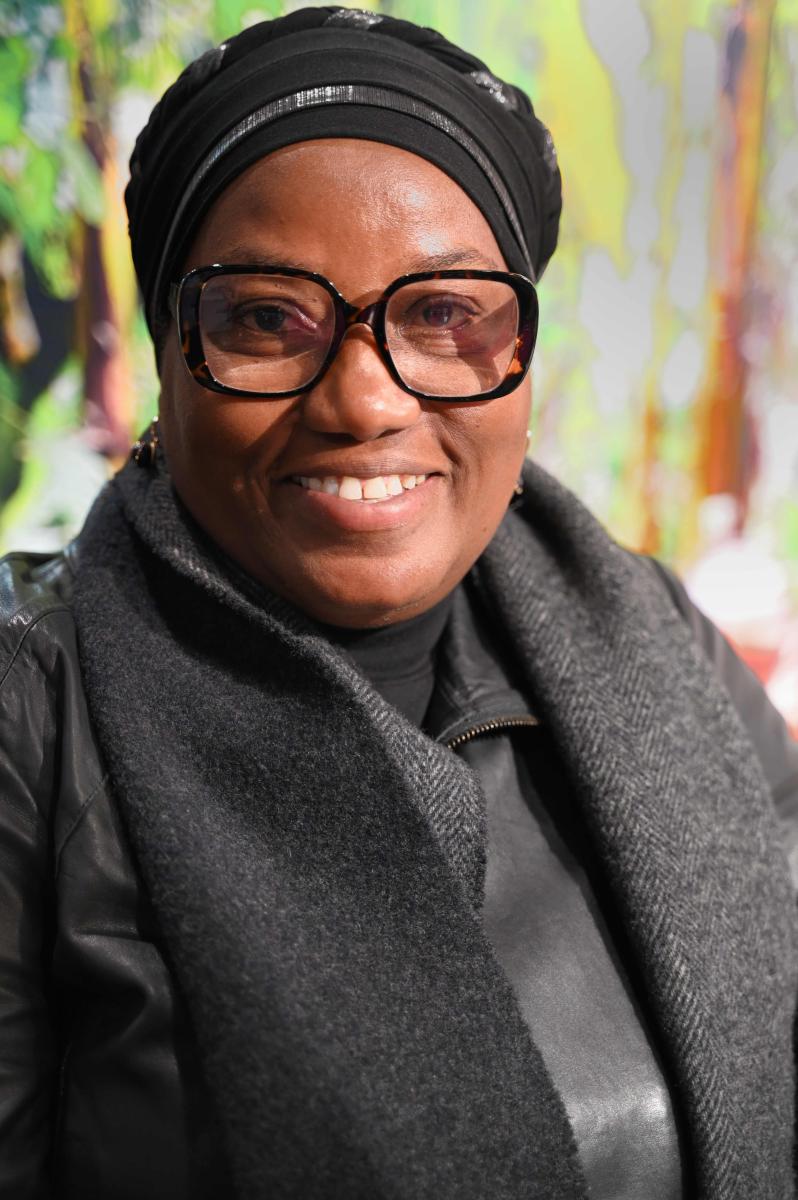
La coopérative ECAM fait le pari de la transformation locale et de la fine saveur
Samuel POOS | 19/11/2026
Il y a quelques années, l'Entreprise Coopérative des Agriculteurs de Méagui (ECAM) était une organisation locale en quête de structuration. Grâce aux efforts de ses membres et à des appuis extérieurs, notamment l'accompagnement du Trade for Development Centre (TDC) d’Enabel, elle a pu développer sa stratégie marketing et consolider son positionnement dans le secteur du cacao biologique. Aujourd'hui, sous l'impulsion de sa présidente Assata Doumbia, ECAM opère un virage important : s'affranchir de la simple collecte pour devenir un acteur ivoirien de la transformation et des « saveurs fines ». Entre 2017 et 2019, ECAM a notamment bénéficié d'un accompagnement en coaching marketing et stratégique du TDC. Portée par cette dynamique et les efforts de ses équipes, la coopérative a vu le nombre de ses producteurs passer d'environ 1 100 à plus de 2 500, et ses volumes de cacao collectés passer de 2 500 à 6 500 tonnes. ECAM a ainsi professionnalisé son image, digitalisé sa traçabilité et obtenu les certifications Fairtrade et Biologique. Ses dirigeants sont devenus des partenaires commerciaux reconnus, capables de présenter un argumentaire structuré à des acheteurs aussi exigeants que Tony's Chocolonely ou Mondelez. Mais pour Assata Doumbia, Présidente du Conseil d'Administration, cette étape n'était qu'un prélude. Aujourd'hui, ECAM ne veut plus seulement vendre des fèves : elle veut maîtriser sa valeur ajoutée. Assata Doumbia a récemment cofondé une association réunissant 32 coopératives et PME ivoiriennes pour faire entendre la voix des petits transformateurs locaux face aux géants multinationaux. L'objectif ? Casser les codes d'un marché trop souvent focalisé sur les volumes. « Nous ne voulons pas rentrer dans ce modèle de transformation industrielle de masse dans lequel l'identité et la typicité du cacao se perdent. Notre objectif est de bien comprendre les attentes des consommateurs européens afin d'adapter notre production. Nous mettons l'accent sur l'excellence, la qualité et les profils aromatiques », explique-t-elle. ECAM veut maîtriser la première transformation (la masse et le beurre de cacao) sur le sol ivoirien, avant d'exporter ces produits semi-finis vers des artisans chocolatiers européens. « Le chocolat ne se conserve pas très bien sous notre climat tropical. En vendant de la masse plutôt que des fèves brutes, nous pouvons déjà revaloriser le prix de vente. » Sur le terrain, la transition est déjà visible. ECAM dispose d'une unité pilote de transformation (5 à 6 kg) qui a fait ses preuves. Un nouvel atelier, respectant scrupuleusement les normes agroalimentaires internationales, est actuellement en construction sur l'emplacement d'une ancienne école de formation. L'ambition est désormais de passer à l'échelle semi-industrielle (500 à 1 000 tonnes) et de sécuriser des débouchés pérennes. Une nécessaire traçabilité Cette montée en puissance vers une première transformation ne peut se faire sans une maîtrise de l’amont et, notamment, sans une mise en conformité avec le Règlement européen contre la déforestation (RDUE) et avec la norme région de cacao durable (ARS1000). ECAM a donc adopté l'outil de traçabilité numérique AGRICE et s'est pleinement investie dans le déploiement de la carte de producteur et des QR codes du Conseil du Café-Cacao (CCC), qui permettent d'identifier et de suivre chaque planteur et chaque lot. « À l'échelle de notre coopérative, nous avons déjà tracé près de 700 tonnes de cacao grâce aux QR codes. Le système n'est pas parfait, mais il est fonctionnel et nous permet de travailler concrètement. 60% de nos producteurs disposent d’une carte. Pour ceux qui n’en ont pas encore, le Conseil du Café-Cacao nous donne un terminal qui génère un numéro pour pouvoir enregistrer le producteur et lancer le processus d’obtention de sa carte», se félicite Assata Doumbia. Le pari des saveurs fines Dans le cadre du projet cacao durable de l’Union européenne mis en oeuvre par Enabel, ECAM a été formée à la production de cacao « fine saveur ». Pour prétendre à ce marché exigeant des cacaos de haute qualité, la rigueur doit être absolue, de la parcelle à l'atelier. Cette exigence a un coût et demande des efforts très importants aux producteurs (formation à la fermentation, distribution de bacs et de claies de séchage, etc.). Le cacao fine saveur d’ECAM est aussi de qualité biologique. Toutefois, « Le cacao biologique demeure très sous-payé et insuffisamment reconnu sur le marché conventionnel en Côte d'Ivoire. Les rares acteurs qui le rémunèrent à sa juste valeur sont des structures issues du commerce équitable. Une structure comme Ethiquable propose un engagement à long terme et un véritable accompagnement technique, ce qui correspond exactement à notre vision pour bâtir une filière bio pérenne », détaille Assata Doumbia. L'an dernier, ECAM a produit 70 tonnes de cacao biologique. Pour maintenir un haut niveau d’exigence, la coopérative a choisi de calibrer sa production autour de 50 tonnes garanties et de ne travailler qu'avec des planteurs pleinement convaincus. « Pour les encourager et les dédommager, la coopérative a instauré une prime de qualité de 400 francs CFA par kilogramme. Ainsi, au prix bord champ officiel de 1 200 francs, nous ajoutons 400 francs, ce qui porte le kilo payé au producteur à 1 600 francs CFA. » Le TDC : un catalyseur de transformations Si ECAM connaît aujourd’hui une belle évolution, le chemin parcouru avec le soutien du TDC constitue un des piliers de son parcours. Entre 2017 et 2019, plus de 25 jours de coaching in situ ont contribué, aux côtés des initiatives propres à la coopérative, à professionnaliser son image, digitaliser sa communication et consolider une gouvernance partagée. L'autonomisation progressive des équipes en a été renforcée. « L'appui du TDC et d'Enabel nous a d'abord apporté une crédibilité et une visibilité. Aujourd’hui, nous avons de quoi convaincre nos partenaires que l’on peut travailler sur tout ce qui est géolocalisation, la bonne gouvernance,... grâce au TDC. L'organisation tourne parfaitement même en mon absence », témoigne la PCA. Cependant, le passage du statut de coopérative agricole à celui d'entreprise agroalimentaire exportatrice révèle de nouveaux besoins. ECAM recherche des partenaires pour une nouvelle phase d'accompagnement, axée sur la maîtrise commerciale des marchés européens de niche, le choix des équipements industriels et leur maintenance. Envie d'en savoir plus sur l'accompagnement du Trade for Development Centre auprès des coopératives en Afrique de l'Ouest ? Contactez nos équipes ou découvrez nos autres projets.
-
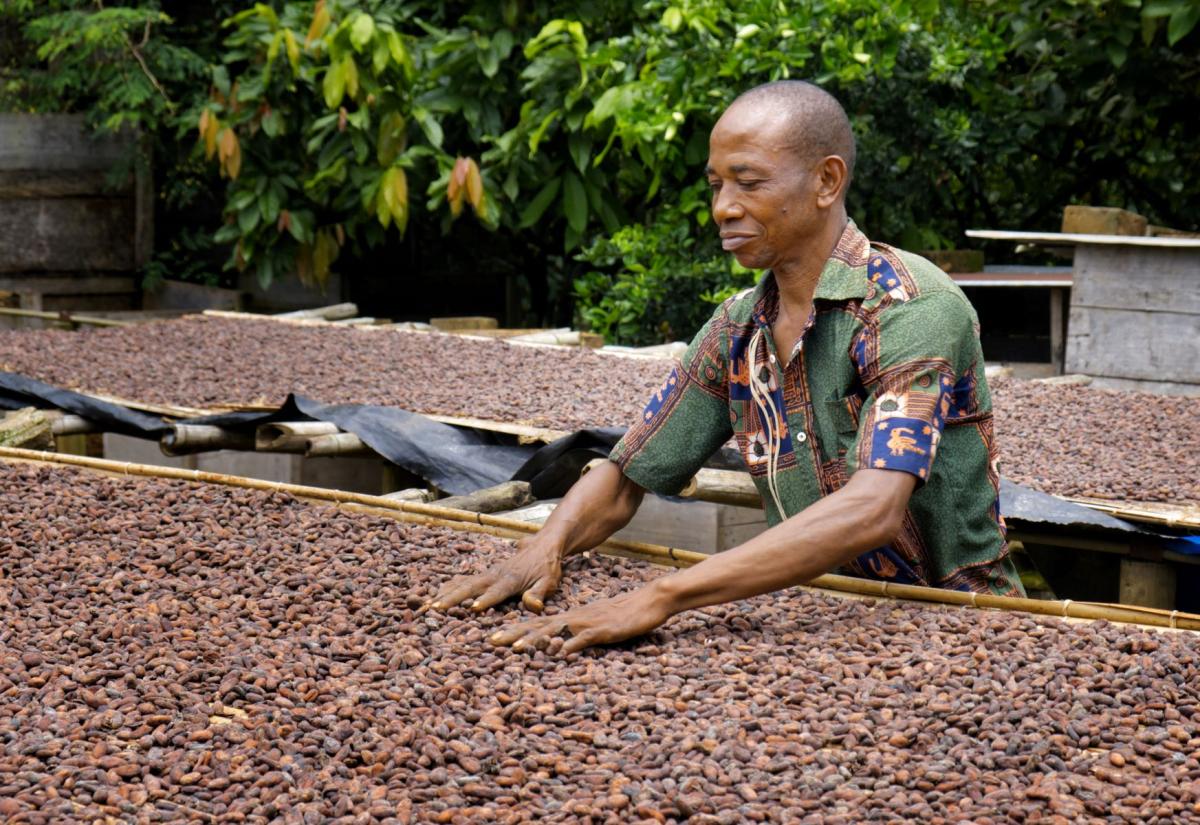
Cacao bio en Côte d'Ivoire : la SCEB garde le cap malgré la tempête
Samuel POOS | 19/11/2026
À Tiassalé, dans le village de M’Brimbo en Côte d’Ivoire, la Société Coopérative Équitable du Bandama (SCEB) vient de rencontrer plusieurs difficultés : certificat bio suspendu, capitaux bloqués et primes des producteurs en attente. La campagne écoulée a laissé des traces. Voici le portrait d'une coopérative éprouvée, mais qui garde le cap, accompagnée par le Trade for Development Centre (TDC) d'Enabel. Une pionnière du cacao bio en Côte d'Ivoire Fondée en 2008 par 34 producteurs, la SCEB est la première coopérative ivoirienne certifiée biologique (Ecocert, depuis 2010). Il faut y ajouter les certifications équitables SPP (Symbole des Producteurs Paysans) en 2018 et Fairtrade en 2026. Aujourd'hui, elle compte environ 388 producteurs actifs, dont une cinquantaine de femmes, répartis dans neuf villages autour de M’Brimbo. Son modèle économique repose sur des partenariats commerciaux durables, notamment avec Éthiquable, et sur des activités diversifiées : biofabrique, agroforesterie, transformation. Le TDC aux côtés de la SCEB depuis 2020 L'accompagnement du TDC s’inscrit dans la durée. Après des coachings en marketing et gestion financière (2020 et 2022) et un premier subside (2021-2023) - qui ont permis de renforcer les capacités de production, de gouvernance et de commercialisation, dont une première participation au salon Biofach et deux nouveaux contrats -, la coopérative bénéficie depuis 2023 d'un coaching en durabilité et travail décent. Objectif : préparer la SCEB au RDUE (le règlement européen contre la déforestation) et au devoir de vigilance en matière de droits humains et d'environnement. Une crise sans précédent La campagne 2025-2026 a mis la coopérative à rude épreuve. Dès les premiers chargements, la suspension du certificat bio par Ecocert a gelé les ventes : le cacao certifié restait bloqué dans les magasins, les capitaux étaient immobilisés et le contrat avec Éthiquable n'a pu être honoré dans sa totalité, faute de trésorerie pour acheter le cacao aux producteurs. Certains d'entre eux, démoralisés, ont vendu hors circuit. La situation interne s'est dégradée : des pertes ont été enregistrées et, pour la première fois, les salaires du personnel ont été payés avec du retard. La prime des producteurs a été réduite et son paiement différé. Un cercle vicieux qui pèse lourdement sur la confiance des producteurs, pourtant au cœur du modèle coopératif, et qui freine l'application opérationnelle sur le terrain des projets de fond comme le SSRTE (monitoring du travail des enfants) ou le déploiement de l'agroforesterie. L'origine du blocage ? Un manque de fonds de roulement structurel. La coopérative, qui avait mobilisé ses réserves pour construire un magasin de grande capacité, ne peut pas emprunter sur le marché local, où les taux d'intérêt sont rédhibitoires. Seuls des financements à l'international (SIDI, Alterfin…) restent envisageables, conditionnés à la tenue rigoureuse des comptes. À cela s'ajoutent des contraintes réglementaires pesant sur la diversification : les intrants de la biofabrique n'étant pas homologués, leur commercialisation externe se heurte à des obstacles légaux et fiscaux. Un redémarrage fragile, mais réel Depuis septembre 2026, les choses bougent. Le certificat bio, suspendu en raison d'une erreur administrative et de questions autour des produits de la biofabrique, a finalement été rétabli, quelques actions correctives restant à mettre en oeuvre. Le cacao a pu être vendu, même si les primes restent en souffrance. Côté commercial, Éthiquable a racheté les volumes, Saco s'engage sur du bio, et le certificat Fairtrade, obtenu trop tard pour cette campagne, est un atout pour la suivante. Pour la campagne 2026-2027, le potentiel de la coopérative reste de l'ordre de 400 tonnes, mais la SCEB cherche activement de nouveaux débouchés pour sécuriser entre 50 et 150 tonnes, en multipliant les contacts directs, notamment avec les acheteurs régionaux. RDUE, SSRTE, agroforesterie : le travail de fond malgré la crise Dans ce contexte tendu, l'accompagnement du TDC, porté depuis 2023 par la coach Dominique Derom, prend tout son sens. Fin 2026, le score de préparation au règlement européen contre la déforestation (RDUE) atteint 88 %, contre 75 % en janvier. Lors d'un entretien accordé fin octobre au salon du Chocolat de Paris, Marc Tanouh, directeur de la SCEB, revient sur l'apport de ce travail de fond : « L'objectif était de vérifier que la coopérative soit au top niveau pour vendre son cacao dans l'Union Européenne. Être au top niveau, cela veut dire : le mapping est-il fait et bien fait ? La traçabilité est-elle en place ? Le système de monitoring du travail des enfants est-il au point ? La carte des producteurs bien distribuée ? Quel est le revenu des producteurs et s’approche-t-il du minimum vital ?… On a passé tout ça en revue. C'était capital pour nous. » Des défis majeurs persistent pour formaliser la traçabilité RDUE : les données cartographiques (points GPS et polygones) manquent encore de précision, et l'infrastructure informatique vétuste de la coopérative complique la centralisation et la sécurisation des données. Un plan de suivi et de remédiation (SSRTE) structuré est prévu dans les semaines qui viennent : sensibilisation par section, visites de ménages, contrôles dans les parcelles et dans les écoles, avec un premier tour de 100 ménages avant la fin de l'année. Carte producteur, ARS1000, paiement digital : le terrain en pleine mutation L'année marque une autre étape : la généralisation de la carte productrice et de la norme ARS1000. « Tous les producteurs n'ont pas encore la carte, mais ce n’est pas un frein pour vendre le cacao » explique Marc Tanouh. « Tu saisis ta direction et elle dépêche les techniciens pour venir produire cette carte. Bien souvent les producteurs qui n’ont pas encore de carte sont ceux qui n’ont pas de papiers.» Côté paiement, la transition est engagée mais progressive : « 80 % des paiements se font encore en cash et 20 % sur la carte. » Quant au système de traçabilité mis en place par l’Etat dans le cadre de l’ARS1000, la norme régionale de cacao durable, « c'est encore en phase d'ajustement, il faut laisser le système se roder », reconnaît le directeur, qui appelle à renforcer les capacités des coopératives par la formation et le recrutement de personnel dédié. SPP : un label de producteurs, pour les producteurs Certifiée SPP (Symbole des Producteurs Paysans), « le label des producteurs, tenu par les producteurs eux-mêmes », la SCEB voit ses membres percevoir une prime de 400 FCFA/kg en plus du prix bord champ de 1 200 FCFA. Le défi ? « Trouver les acheteurs. » La coopérative organise d'ailleurs l'assemblée régionale africaine du SPP à Yamoussoukro pour promouvoir le label auprès des acheteurs et du Conseil du Café-Cacao. « Un petit programme, mais vital » Malgré une campagne 2025-2026 difficile, suspension temporaire du certificat bio, capitaux gelés, primes payée en retard, Marc Tanouh conclut l'entretien par un appel en faveur du TDC : « Le Trade for Development Centre est un petit programme d’Enabel. C'est ce programme-là qui doit continuer. Si vraiment tous ceux qui ont bénéficié du TDC le demandent, je pense que le peuple belge va comprendre qu'il est très important de vous soutenir. Ce que nous demandons, c'est que le TDC existe toujours pour accompagner les producteurs vulnérables. »
-
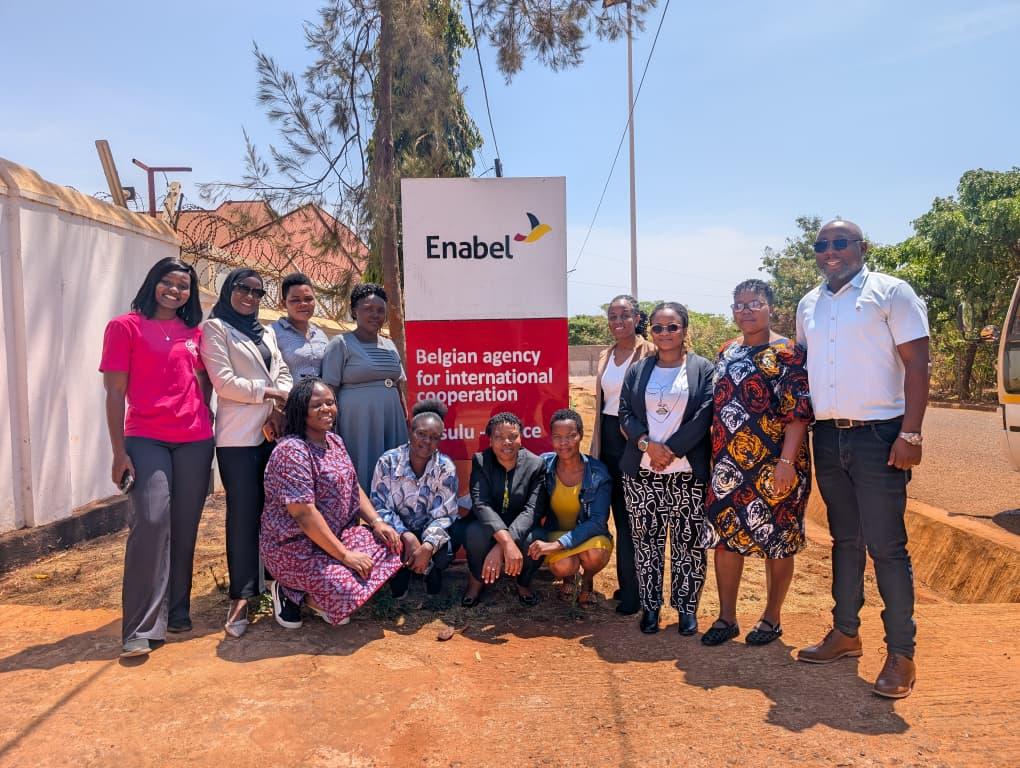
Inspiring the next generation of women in STEM: Meet Tanzania’s first WLICT STEM Role Models
Tom CROHIN | 13/11/2026
As part of WLICT’s efforts to increase girls’ and young women’s participation in STEM and ICT, eight women professionals from diverse STEM fields were selected and trained as role models in Tanzania. Drawn from both national and local levels in Kigoma Region in western Tanzania, the cohort spans fields such as computer science, digital skills, health, education and aquatic sciences, introucing girls to a diverse range of STEM career pathways. Through training on mentoring, communication, safeguarding and school engagement, they were equipped to support and inspire girls in pursuing STEM studies and careers. The programme concluded with a practical outreach exercise at Ruhita Secondary School in Kasulu, where the role models engaged 30 STEM Club members and put their newly acquired skills into practice. These role models will form the basis of a national network in Tanzania, helping strengthen STEM clubs and increase the visibility of women in STEM fields. Beyond Tanzania, Enabel is working to identify and train role models in Senegal, Mozambique, Jordan and Ukraine. Together, these national networks will be connected through an international Community of Practice, creating opportunities for peer learning, cross-country collaboration and the sharing of experiences and good practices. By fostering both local and global support networks, WLICT aims to increase girls’ awareness of STEM opportunities, strengthen support systems for young women and contribute to a more inclusive digital future. Bonita Mpokwa, Retention Education Expert as part of Enabel's Wezesha Binti project in Tanzania attended and supported the workshop. "One thing that really stood out for me, she said, was realising how powerful it can be for young people to hear the stories of people who have walked a journey similar to theirs. The role models we trained have achieved different things, but behind those achievements are stories of challenges, difficult moments and circumstances that are not so different from what many young people, particularly girls in Kigoma, are experiencing today. I think there is something powerful about a young girl seeing someone who has gone through similar challenges and realising that her circumstances do not have to define how far she can go."
-
Twenty-one Centres of Vocational Excellence advancing Gender Inclusion in STEM
Tom CROHIN | 09/11/2026
Centres of Vocational Excellence across Ukraine are taking concrete steps to make STEM and technical education more accessible and inclusive for girls and women. Initially, eleven CoVEs conducted gender self-assessments and developed gender-transformative action plans to identify and address barriers affecting women’s participation in technical education and employment. These plans were presented during a WLICT webinar held on 15 September 2026, opened by Ms Shumik, Director General for Vocational Education and Training at the Ministry of Education and Science of Ukraine. Following the strong interest and quality of the proposals received, Enabel mobilised complementary funding from its bilateral portfolio to extend support to 10 additional CoVEs in Ukraine, increasing reach and replication potential. A second webinar took place on 4 November 2026, during which the newly enrolled Centres presented their action plans and expected results. Through direct grants, the CoVEs will implement these tailored initiatives to attract, retain and support girls and women in STEM pathways. Planned activities include awareness-raising campaigns, role model and mentoring programmes, targeted training opportunities, partnerships with employers, improvements to learning environments, and measures to strengthen women’s transition from education to employment. By testing and institutionalising gender-transformative practices, the initiative aims to create lasting change in vocational education and expand opportunities for girls and women in STEM careers.Implementing actor(s): Enabel, Centres of Vocational Excellence (CoVEs) in Chernihiv, Kyiv, Lviv, Odesa, Dnipro, Uzhorod, Kalush, Vinnytsia, Rivne, Kolky, Skvyra, Bila Tserkva.Partners: Centres of Vocational Excellence (CoVEs): Vocational Lyceum of Ukrainka , Bila Tserkva Higher Vocational School of Construction and Services, Snovsk Higher Vocational School of Forestry, Pereiaslav Vocational College, Chernihiv Higher Vocational School, Boryspil Vocational College, Chernihiv Center for Vocational and Technical Education, Chernihiv Professional Construction Lyceum, Brovary Vocational College, Chernihiv Vocational Lyceum of Railway Transport, Skvyra Higher Vocational School , Higher Vocational School of Tulchyn” of Vinnytsia Regional Council, Dnipro Professional Technological College, Kvasyliv Vocational Lyceum, Odesa Center for Vocational and Technical Education, Uzhhorod Vocational Education and Training Centre, Kyiv Vocational College TECHNO-ART, Lviv Interregional Higher Vocational School of Railway Transport, Chortkiv Higher Vocational School, Higher Vocational School No. 7 in Kalush, Kolky Center for Vocational Education Ministry of Education and Science of Ukraine (DG VET)
-
Building more sustainable food systems through agroecology in Rwanda
Guido COUCK | 03/11/2026
Agriculture is at the heart of Rwanda’s economy. It accounts for around 25% of national income and provides a livelihood for most rural families. But farmers are facing increasing pressure from climate change, soil degradation, population growth and shrinking farm sizes. More than 90% of Rwanda’s farmers are smallholders, many cultivating less than 0.7 hectares of land. Around 40% of the country’s land is also vulnerable to soil erosion, which threatens agricultural productivity.At the same time, many farmers rely on costly fertilisers, pesticides and seeds. This can increase production costs and, when poorly managed, put additional pressure on soils, biodiversity and the environment.The EU-funded DeSIRA+ programme aims to make food systems more sustainable and resilient in Rwanda, Burundi and the Democratic Republic of Congo. It builds on the earlier DeSIRA initiative and promotes agroecology, a way of farming that makes better use of natural processes while helping farmers maintain or improve production.In practice, this can include improving soil fertility with organic methods, integrating trees into farmland, reducing soil disturbance, managing pests more sustainably, collecting rainwater, and combining crop and livestock farming. These approaches can help farmers improve soil health and biodiversity, reduce their dependence on expensive inputs, and become more resilient to climate change.What will the project do in Rwanda?In Rwanda, DeSIRA+ will bring together farmers, cooperatives, small businesses, food processors and traders, as well as public institutions, researchers, universities and civil society organisations. Particular attention will be given to women and young entrepreneurs.Rather than promoting a single solution, the project will identify and test promising ideas together with farmers and other partners. Successful approaches will then be expanded so that more people can benefit from them.The project will support this through grants for innovative ideas, farmer-led trials, demonstration sites, training and technical support. It will also strengthen cooperation between farmers, researchers, businesses and public authorities and contribute to discussions on policies that can support agroecology in Rwanda.What does the project aim to achieve?By the end of the project, DeSIRA+ aims to:test around five promising agroecological innovations and expand at least two successful solutions;support more than half of participating farmers to adopt agroecological practices;help around half of supported producers increase their productivity and incomes;strengthen the capacities of at least 17 organisations;establish or reinforce at least three partnerships bringing together different actors in the food system;contribute to the integration of agroecology into national policies and planning;ensure that women and young people represent at least 20% of participants in supported innovation partnerships.Investment and long-term ambitionUltimately, the programme aims to help build a food system that is more productive, more resilient to climate change and better for the environment, while increasing farmers’ incomes and strengthening cooperation across the region.
-
The Digital Innovation for Education (DI4E) Scaling Project
Guido COUCK | 03/11/2026
The Digital Innovation for Education (DI4E) Scaling Project, implemented under the Regional Teachers Initiative for Africa (RTIA), aims to strengthen teachers' digital competencies and improve the quality of teaching and learning across Sub-Saharan Africa. Many schools and educators face challenges in accessing digital tools, learning resources, connectivity, and professional development opportunities needed to effectively participate in the digital transformation of education. As a result, teachers are often unable to fully support learners in acquiring the digital skills required in an increasingly technology-driven world.The project seeks to transform digital education by addressing barriers that limit effective teaching and learning. Specifically, it aims to:Strengthen teachers' digital and pedagogical competencies.Promote the meaningful integration of educational technology into classroom practice.Improve access to digital teaching and learning resources.Foster collaboration and knowledge sharing among educators.Expand opportunities for continuous professional development in digital education.To achieve these objectives, the project is implemented through:Innovation Hubs, which provide collaborative spaces where teachers can access internet connectivity, create and download digital resources, participate in training activities, collaborate with peers, and share knowledge and experiences.Digital Mobile Toolkits, equipped with tablets, projectors, and other digital learning devices that support the integration of technology into classroom practice.Continuous capacity building and pedagogical support, ensuring teachers can effectively use digital technologies to enhance teaching and learning outcomesThe project primarily benefits teachers, students, schools, and education authorities. Teachers gain access to digital tools and professional development opportunities, while learners benefit from more engaging and technology-enhanced learning experiences. Schools are strengthened through improved access to digital infrastructure and resources, and education authorities benefit from innovative approaches and capacity-building initiatives that support digital education planning and governance. The project is implemented through a partnership involving the Regional Teachers Initiative for Africa (RTIA), the European Union, UNESCO, the African Union Commission, Enabel, and Ministries of Education in participating countries. Expected results include stronger digital competencies among teachers, increased use of technology in classrooms, improved teaching and learning experiences, enhanced collaboration among educators, and the development of future-ready digital skills among learners. The project also aims to establish sustainable models for continuous teacher professional development through digital innovation.The DI4E Scaling Project is implemented in Rwanda, Uganda, and Tanzania. The broader Regional Teachers Initiative for Africa (RTIA) runs from 1 February 2024 to 31 January 2030.
-
Express your Interest – Training of Trainers programme West Africa
Nicoletta FAVARETTO | 19/10/2026
Calling West African Business Support Organisations! Applications are open for the second cohort of the EU CERC Training of Trainers Programme. Are you a Business Support Organisation (BSO) working in WestAfrica, particularly in Ghana or Nigeria? The EU Circular Economy Resource Centre (EU CERC) in collaboration with Circle Economy Foundation is inviting BSOs to join its Circular Economy Training of Trainers Programme, designed to help organisations move from awareness to action and strengthen their capacity to support businesses in adopting circular economy approaches. The circular economy ToT programme will focus on electronics and ICT, batteries and related value chains The programme includes:An orientation session A two-day online Training of Trainers 4–6 months of follow-up support Practical tools, case studies, and peer exchange Support to apply circular economy approaches within your organisation and networks Space to work through real-world implementation challenges Practical tools, case studies, and peer exchange Support to apply circular economy approaches within your organisation and networks Space to work through real-world implementation challenges Practical tools, case studies, and peer exchange Support to apply circular economy approaches within your organisation and networks Space to work through real-world implementation challengesThe programme will run until 2028, with cohorts taking place across different regions. The second cohort is dedicated to West African BSOs and starts in November 2026. APPLY NOW:Express your interest by 5th November 2026: https://forms.cloud.microsoft/e/V6byvGMDF1 INFORMATION SESSION:Want to find out more before applying? Join our online information session: 27 October 2026 13:00–14:00 CET (UTC+1)Register: https://us02web.zoom.us/meeting/register/9z9NPB5hQGqlkUj2_rumgwFore more information, please visit the dedicated ToT page here: The Circular Economy Training of Trainers (ToT) Programme - Sitra
-
Minister Maxime Prévot Kicks Off Fair Trade Week in Belgium
Samuel POOS | 08/10/2026
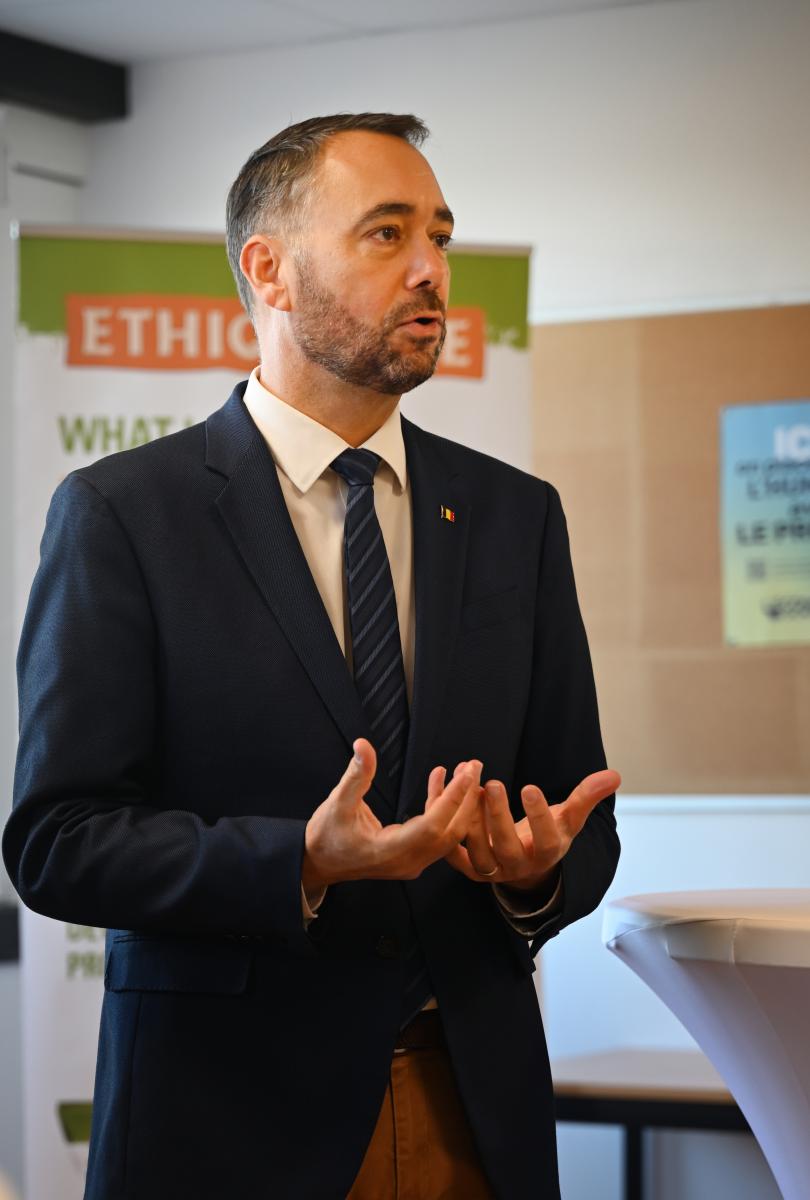
From cocoa produced in Côte d’Ivoire to pralines made in Namur: fair trade creates tangible links between producers and consumers.Minister Maxime Prévot officially launched Fair Trade Week (October 7–17) with a visit to the Ethiquable Benelux cooperative, which sources its cocoa in part from the Ivorian Société coopérative Equitable du Bandama (SCEB), supported by Enabel’s Trade for Development Center. There, he toured Ethiquable’s brand-new chocolate workshop, where pralines are made from fair trade cocoa.In Côte d’Ivoire, SCEB is one of the cooperatives committed to addressing the challenges facing the cocoa sector. With Enabel’s support, it has been able to double its organic production and better prepare for European requirements regarding deforestation and child labor. “As Minister of Development Cooperation, I had the opportunity to travel to Côte d’Ivoire and visit cocoa plantations. It was a particularly memorable experience, because that is where one truly becomes aware of the conditions under which cocoa is grown, harvested, and processed. This experience further convinced me of the great added value of purchasing these products in a conscious and responsible manner, as they hold immense human value,” said the minister.“That is why I believe it is important to continue this fight. Despite the pressures we face today, I am more convinced than ever that international cooperation is an essential part of a larger whole. We live in a highly interconnected world. What happens there has consequences here—and vice versa. A new edition of Fair Trade Week begins tomorrow, and I think this initiative is truly meaningful!” the minister concluded.Check out the program for Fair Trade Week, coordinated by Enabel's Trade for Development Centre: https://semaineducommerceequitable.be/apercu-des-activites/
-
International Coffee Day - World of Coffee
Samuel POOS | 02/10/2026
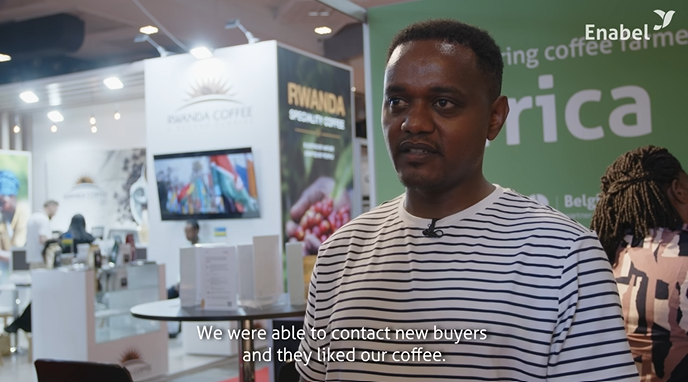
On the occasion of International Coffee Day, October 1, we are showcasing the exceptional quality of African coffee. During the latest edition of World of Coffee in Brussels – the world’s leading event dedicated to specialty coffee – Enabel’s TDC organised an official cupping session that brought together a large audience of international buyers, importers and professional coffee roasters. Seventeen producer organisations and companies from Uganda, the Democratic Republic of Congo, Ethiopia, Burundi, Kenya and Tanzania gave visitors the opportunity to discover the quality and delicate flavours of their coffees. This important commercial showcase generated numerous direct business contacts and contributed to strengthening the position of African specialty coffee on the global market.Here is the link to the video : EN: https://www.youtube.com/watch?v=ANNueBnDFbUFR: https://www.youtube.com/watch?v=NDmZC9Ow6L4
-

Quand les planches éveillent les consciences : le théâtre au cœur de la Semaine du commerce équitable
Samuel POOS | 24/09/2026
Sensibiliser et promouvoir une consommation plus juste relève souvent du défi. Comment aborder des sujets aussi complexes que les chaînes d’approvisionnement agricoles ou les ravages de la fast fashion sans verser dans un discours moralisateur ou trop théorique ? C’est précisément là que l’outil théâtral est intéressant. En donnant corps et voix à des réalités humaines, en mobilisant le rire, l’émotion et la mise en situation, le spectacle vivant crée une passerelle directe et sensible avec le spectateur. Du théâtre-action au théâtre-forum participatif, la scène bouscule les certitudes, aiguise l’esprit critique et transforme le public en citoyen actif. Pour cette édition 2026 de la Semaine du commerce équitable, les créations investissent salles, écoles et centres culturels à travers la Belgique pour éclairer, questionner et débattre. Découvrez notre programmation théâtrale ! Cacao Quest : l’immersion dystopique au cœur du marché du chocolatConçue par la compagnie Tadam en étroite collaboration avec le Trade for Development Centre (TDC) d’Enabel, « Cacao Quest » est une aventure mordante destinée aux jeunes de plus de 16 ans.Dans un futur pas si lointain, où le chocolat est devenu un produit de luxe aussi rare que l’or, trois adolescents, Emilio, Nelson et Lucia, découvrent dans une ruelle un sac mystérieux rempli de barres de chocolat. Dans un premier temps, ils sont enthousiastes face à leur trouvaille, mais ils réalisent rapidement que ce trésor soulève de nombreuses questions : d’où vient-il ? Et surtout, que faire de ce butin inestimable ? Lorsqu’ils goûtent ce produit précieux pour la première fois, leurs sens sont stimulés et ils entament une enquête qui les mène de l’autre côté du monde, en Côte d’Ivoire, où cette histoire commence. Ils suivent la chaîne du cacao : les plantations qui dévorent la forêt, les enfants qui travaillent sous un soleil brûlant, les agriculteurs sous-payés qui luttent pour survivre tandis que l’industrie du cacao engrange d’énormes profits. Partagés entre le désir de tout garder pour eux et la responsabilité d’agir, les trois adolescents se lancent dans leur quête : ils cherchent à comprendre d’où vient le chocolat qu’ils tiennent entre leurs mains et le parcours qu’il suit avant d’arriver dans nos rayons. Comment peuvent-ils lutter contre un marché dominé par de grandes entreprises ? Doivent-ils vendre leur trésor et tout garder ? Le partager ? Ou au contraire le détruire ? Cette pièce explore notre relation au consumérisme, au commerce équitable et aux problématiques liées à la mondialisation. Rendez-vous phare de la Semaine, la pièce sera présentée le dimanche 11 octobre 2026 à Bruxelles lors de la 19ᵉ Conférence Internationale des Fair Trade Towns, ainsi que dans des écoles partenaires (comme au Collège de la Lys à Comines-Warneton), ou dans des centres culturels (mardi 7 octobre à Braine-l’Alleud). Le commerce équitable, c’est quoi cette arnaque ? Portée par l’ASBL marchoise Alvéole Théâtre, cette conférence théâtralisée de 55 minutes (accessible dès 16 ans) mise sur un humour grinçant pour démonter les idées reçues. Sur scène, trois points de vue s’affrontent sans concession : un professeur d’économie, une animatrice d’ONG et une agricultrice de terrain. Loin de tout ton moralisateur, le trio s’appuie sur des faits documentés pour interroger la pertinence des labels et nos réflexes de consommation, avant de prolonger la soirée par un débat avec des spécialistes. Trois dates sont prévues en Wallonie : le mercredi 7 octobre (20h15) à l’Espace Culture de Fléron, le samedi 10 octobre (19h00) à la Maison de la Laïcité de Tournai, et le mercredi 14 octobre (20h00) au Complexe sportif et culturel d’Etalle. Qui a volé l’orange ? Inspirée par la célèbre méthode du théâtre-forum d’Augusto Boal, la compagnie de théâtre-action Le rire de la lune (en collaboration avec le CNCD-11.11.11) propose une version réactualisée de son spectacle sur la filière du jus d’orange. On y suit les déboires de Roberta Ramirez, petite paysanne brésilienne écrasée par une multinationale, sur fond d’enjeux liés au Mercosur et aux pesticides. La grande force de ce spectacle réside dans son interactivité : après 20 minutes de jeu, le public est invité à monter sur les planches pour remplacer un personnage et tester des solutions collectives face à l’injustice. Ce sont huit représentations gratuites et itinérantes qui sont prévues entre le 7 et le 17 octobre 2026 dans divers espaces associatifs, maisons de jeunes et écoles à travers Bruxelles et la Wallonie. Le Procès du Commerce Équitable À Neufchâteau, le théâtre-action se mue en véritable arène judiciaire ! La Ville et ses partenaires organisent une audience pas comme les autres où les certitudes et les controverses entourant les filières éthiques seront passées au crible. Les séances se tiendront le jeudi 8 octobre 2026 à l’Espace 29 de Neufchâteau (Rue des écoles). Si les deux premières représentations sont destinées aux élèves du secondaire de la région, la séance du soir s’ouvre au grand public et sera précédée d’un convivial buffet paysan valorisant des produits locaux et équitables. Notre(sur)vie en terre agricole Initiée par Hainaut Développement et accompagnée par le Théâtre des Rues, cette œuvre se distingue par son authenticité absolue : elle est le fruit de longs mois d’écriture et de répétitions menés par une dizaine d’agriculteurs et agricultrices du Hainaut eux-mêmes. Témoignage poignant sur le quotidien paysan et les pressions économiques, la pièce sera proposée sous la forme d’une captation vidéo le mardi 13 octobre 2026 (de 19h à 21h) à Mons. La soirée se prolongera par un temps de rencontre privilégié avec les agriculteurs-comédiens et une dégustation des produits de leurs fermes. La revanche de la carotte (moche) Destinée aux plus jeunes, cette comédie clownesque aborde avec tendresse et drôlerie les mécanismes du gaspillage alimentaire. En personnifiant des légumes rejetés des circuits de vente pour de simples critères esthétiques, la pièce de la Cie les Carottes sont cuites invite les enfants à questionner les diktats de la grande distribution et à célébrer la différence. Le spectacle sera joué le jeudi 8 octobre 2026 au Centre sportif et culturel d’Etalle, spécialement devant les classes de la 1re à la 4e primaire de la commune. La fusée poubelle Embarquement immédiat pour les tout-petits ! Présentée dans le cadre du programme de sensibilisation scolaire de la Ville de Soignies (en partenariat avec l’intercommunale Hygea), cette animation théâtrale s’adresse aux élèves de maternelle et du début du primaire. À travers une narration colorée et ludique, le spectacle aborde la réduction des déchets et le cycle de vie des objets, semant les graines d’une conscience écoresponsable dès le plus jeune âge au sein des écoles de Soignies. C’est pas cousu d’avance S’attaquant aux coulisses sombres de l’industrie textile et à la frénésie de la fast fashion, ce spectacle offre une réflexion sans fard sur notre consommation vestimentaire. La pièce lève le voile sur les conséquences humaines et environnementales qui se cachent derrière nos étiquettes à bas prix. Elle sera jouée sur les planches du Centre culturel de Wanze le 16 novembre 2026, à l’attention des élèves de 6e primaire de la commune dans la continuité des ateliers sur les principes du commerce équitable. Pour plus d’information : samuel.poos[@]enabel.be
-
From Blockchain to Local Brews: Inside Uganda’s ACPCU
Samuel POOS | 18/09/2026
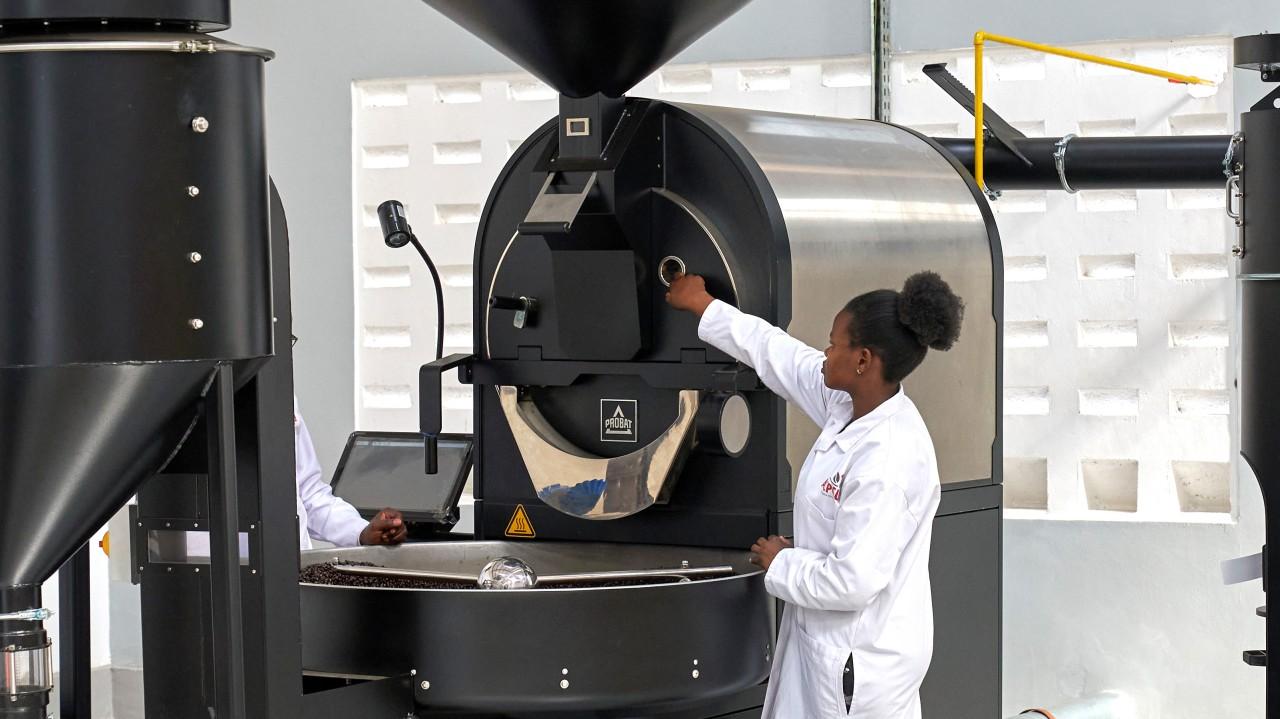
The Ankole Coffee Producers Cooperative Union (ACPCU) sits at a curious crossroads: a union rooted in the hills of south-western Uganda, yet increasingly wired into blockchain ledgers, EU regulatory frameworks and NFC-enabled farmer cards. In a wide-ranging conversation with TDC, Derrick Komwangi, ACPCU's Projects Officer, spoke candidly about regulation, income, digitisation, youth and the union's ambitions for the next decade - and along the way, dismantled a few assumptions about what is actually keeping Ugandan coffee farmers up at night.Navigating the European regulatory landscapeMuch of the international conversation around African coffee exports currently centres on the EU Deforestation-free Regulation (EUDR). ACPCU, which sends the vast majority of its coffee to Europe, might be expected to be nervous. Komwangi is not. "EUDR is part of the growing regulations in the European Union, which is a major market for us, as about 90% of ACPCU's coffee goes to the EU region. A government programme, alongside assistance from the aBi and the European Union, helped map about 29% of our farmers," Derrick Komwangi said. His verdict on the regulation that has dominated headlines is blunt: "To be honest, EUDR is not as big a challenge as people portray it to be."The real disruption, he argued, has come from elsewhere. "For us, the biggest challenge and impact came from the new EU organic regulation. Its impact was far-reaching and devastating compared to the EUDR." The sticking point is structural. "We have been lobbying against them, specifically regarding the legal entity requirements which conflict with the structure of cooperative unions. We hope this requirement will be reduced or reversed," Komwangi said.*Sustaining a living income beyond market fluctuationsEnsuring a living income for farmers remains a core mission for ACPCU. Fortunately, current market dynamics are favourable. "The current price is far above the living income benchmark for Uganda, because the market has gone up," Komwangi explained.This surge has proven that "the consumers can take the living income prices, and even far above that," which has led to a tangible impact on the ground. "We are seeing farmers take up new seedlings with limited or no subsidy," he observed, showcasing a renewed investment in farm production.However, ACPCU is not relying solely on high market prices. "Living income is a destination with very many pathways towards it". To boost productivity, currently "about 40% below the optimum", the union is turning 1.5 million kilogrammes of organic coffee husks into fertiliser.Other levers sit outside the farm gate entirely. "Since 57% of what affects the living income relates to off-farm factors like education and health, we are running a health insurance programme," Komwangi said. "In its first year, we already have about 900 paid doctor visits for our farmers, 62% of whom are women." The logic, he said, is straightforward: "This buffers their income from being expended on health shocks."Digitising the value chainSupported by a TDC grant, ACPCU is partnering with Fairfood to pioneer digital traceability, equipping farmers with Near Field Communication (NFC) cards. "The farmer will swipe their card against the phone in the cooperative's office and it will bring the details of this farmer," Komwangi detailed. This real-time data goes onto a blockchain, allowing the final consumer to "scan the code and know that this coffee came from this very farmer and that they were paid this amount".Regarding data sovereignty, ACPCU relies on detailed consent forms, as only "about 17% of farmers have data" or smartphones. Komwangi emphasised that transparency is key to maintaining trust: "So long as farmers can see tangible benefits coming to them, they do not have a problem with providing such data. The trust is broken when all this information is requested... but the market does not want to give anything in return".Cultivating a local marketYears ago, a coaching programme run under the TDC observed that ACPCU tended to lean on external partners rather than build its own marketing muscle. That has since changed dramatically, not least with the establishment of an in-house local marketing department."Our approach has changed significantly, and we have seen a very sharp rise in our local sales volume," Komwangi said. The scale of that shift is hard to miss: "We went from handling 500 kg to 6 tonnes this year, and our local monthly revenue grew from 500,000 to around 20 million shillings (around €4,639)."The ambition doesn't stop there. "Our medium-term target is to sell one container locally," he said, framing why that single container matters so much: "One container sold locally is equivalent in value to four exported containers. If we can scale up to 10 containers locally over the next decade, that will equal the value of 40 exported containers, and that premium can be used to buffer the living income gap."Uganda still has a long way to go compared with its regional neighbour. "Local coffee consumption in Uganda is currently below 5%, compared to 50% in Ethiopia, but it is increasing thanks to sales promotions and advertising supported by the grant," Komwangi said.The TDC grant and a previous investment in the ACPCU’s roasting operations have enabled the organisation to refine its business model. "This ongoing support and our previous investment in the roastery have dramatically reduced our cost of production," he said. The union’s packaging strategy has also been reviewed: "Previously, we only sold coffee in units up to 500 grams to 1 kg. We have now downsized our packaging to 20-gram sachets sold for 1,000 shillings, which has become our cash cow, representing 80% of our local market sales." An even smaller format is on the way: "We plan to introduce a 10g single sachet."Training for a cooperative society.Bringing young people back to coffeeACPCU has lifted youth participation in its supply chain from 4.1% in 2020 to 13% in 2025, a shift Derrick Komwangi links directly to succession planning. "With our elderly farmers averaging around 56 years old, ensuring succession is vital," he said. "We want to make coffee farming a gainful, decent business rather than just an inherited chore."Concrete incentives have driven the change. "To achieve this, all our cooperatives offered a 30% reduction on buying shares for young people, which led to a significant hike in youth engagement. We have also trained youth as service workers to support elderly farmers and bridge value chain gaps," Komwangi said.Getting young Ugandans to actually drink the coffee they help produce is a separate battle. "We need the younger generation to consume the coffee. Since the local young population views coffee as a functional product for a caffeine boost rather than a lifestyle, we are targeting universities and local football clubs to shift behaviours," Komwangi said. The product range is set to evolve accordingly: "Over the next five years, we plan to explore iced coffee and cold brews to match their preferences."A vision for 2031: science, innovation, and growthLooking ahead to the 2026 - 2031 period, ACPCU has an ambitious vision to support "50,000 smallholder farmers" and process "500 containers". Product innovation is at the forefront, with a shift towards experimental processing, such as the "use of yeast, fermentation, inoculation" for honey-processed coffees, which provides a "more stable high quality" and a "bigger margin that we can play with to give back to the farmer".Derrick Komwangi views this R&D push as a matter of long-term survival, likening the challenge to the foresight required for New York’s development in the 1800s. Just as city planners then had to build infrastructure for a future metropolis without knowing exactly how transport technology would evolve, ACPCU is investing in science and knowledge now to ensure the cooperative’s longevity. "If we do not invest in the knowledge," he reflects, "then we will not be here. We have already had the approval of the management and the Board to start a small science lab," Komwangi shared. This will allow them to conduct chemical residue tests locally rather than shipping expensive samples to Europe. Summing up the cooperative union’s forward-thinking philosophy, he concluded: "If we don't invest in knowledge, we won't be there... We must work on research, knowledge for the farmers themselves".What emerges from the conversation is a cooperative treating regulation, data and youth engagement not as separate compliance boxes to tick, but as interlocking pieces of the same long-term strategy: keeping Ugandan coffee - and the farmers who grow it - competitive for decades to come.Interview conducted by Samuel Poos, Project manager of Enabel’s Trade for Development Centre, on 27 June 2026.* The regulation sometimes forces organisations to split artificially, with no more than 2,000 members per group permitted. For more information, read this TDC article: European organic regulation: progress and challenges for small producers in third countries.
-
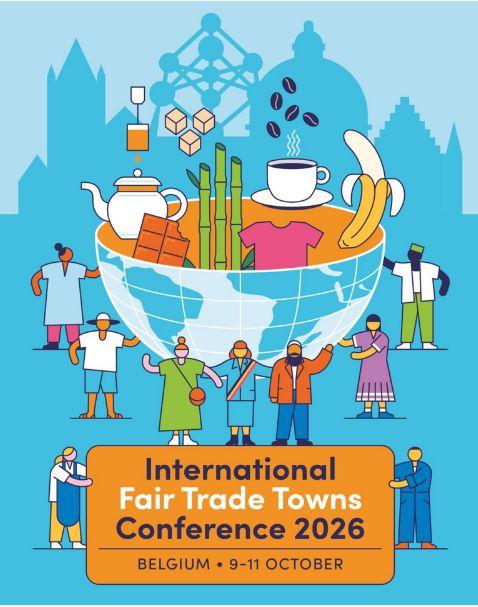
Belgium to host the 19th International Fairtrade Towns Conference.
Samuel POOS | 17/09/2026
From 9 to 11 October 2026, Belgium will welcome around a hundred campaigners, policymakers, activists and engaged citizens from across the globe for the 19th International Fair Trade Towns Conference (IFTTC).Held under the theme "Local Change for a Global Future", the event will explore how Fair Trade Towns can drive meaningful, lasting change worldwide.A unique Belgian approachThe conference is organised by Faire Gemeente Vlaanderen and Communes du Commerce Equitable Wallonia and Brussels, together with partners including the Belgian agency for international cooperation, Enabel.Belgium's Fair Trade Towns programme stands out internationally. Beyond the five recognised global criteria, Belgian towns and cities adhere to a sixth national criterion promoting sustainable local food. In Flanders, the movement goes even further through its "Next Level" criterion, linking fair trade with ethical banking, fair fashion, fair ICT, and circular economy initiatives. Three days of inspiration, exchange and actionFriday 9 October: Focus on European institutions, public policy and sustainable public procurement. The day will feature a debate with active participation from Enabel, the Belgian agency for international cooperation, exploring how public policy can advance fair trade objectives. The opening will culminate in an introductory conference where Jean Van Wetter, CEO of Enabel, will present "The Impact of Fair Trade in Belgium and Worldwide", underscoring the agency's commitment to fair trade and sustainable development.Saturday 10 October: Field visits to three inspiring Belgian Fair Trade Towns: Namur (Wallonia), Brussels, and Ghent (Flanders). Each will showcase local initiatives in fair trade and sustainable development.Sunday 11 October: A full day of exchange, inspiration and debate. Belgian and international speakers will share their vision on activism, the concrete impact of fair trade on producer communities, and the ssential role of local engagement in building a fairer world. A key highlight will be a French-language performance of Cacao Quest, an interactive educational theatre play created by Tadam and Enabel's Trade for Development Centre. Why it mattersThe IFTTC brings together campaigners, organisations, enterprises, policymakers and communities to plan together and strengthen the global fair trade movement. With sessions on international regulation, sustainable procurement, citizen activism and movement renewal, the programme promises rich opportunities for learning, debate and networking. More information and registration: www.ifttc2026.be
-

Expression of Interest: EU CERC Cities and Local Authorities Programme
Nicoletta FAVARETTO | 10/09/2026
Are you a city or local authority in Africa, Latin America or Asia? The EU Circular Economy Resource Centre (EU CERC) is inviting cities in ODA recipient countries to apply for the a tailored capacity-building programme of the Business Lab designed to help cities better understand their local circular economy opportunities, strengthen their capacity to develop and advance circular economy initiatives, and engage with relevant stakeholders. Over four months, selected cities will receive expert guidance and structured support to assess their local circular economy landscape, identify and develop promising circular economy opportunities and projects, and engage with their business community. Subject to clear selection criteria, eligible cities may also be considered for short-term technical assistance to support the further development or implementation of selected circular economy initiatives. Responses will be reviewed against a set of strategic criteria covering policy alignment, circular economy ambition, inclusivity considerations, implementation capacity, and expected long-term contribution.Up to three cities will be selected on a rolling basis. The programme starts in November 2026 and it is implemented by Circle Economy Foundation.Apply by 12 October 2026: Fill out the EoI form Join our info session to learn more: Info Session EU CERC Support to Cities When? 21 September 2026 - 15:00-16:00 CEST
-
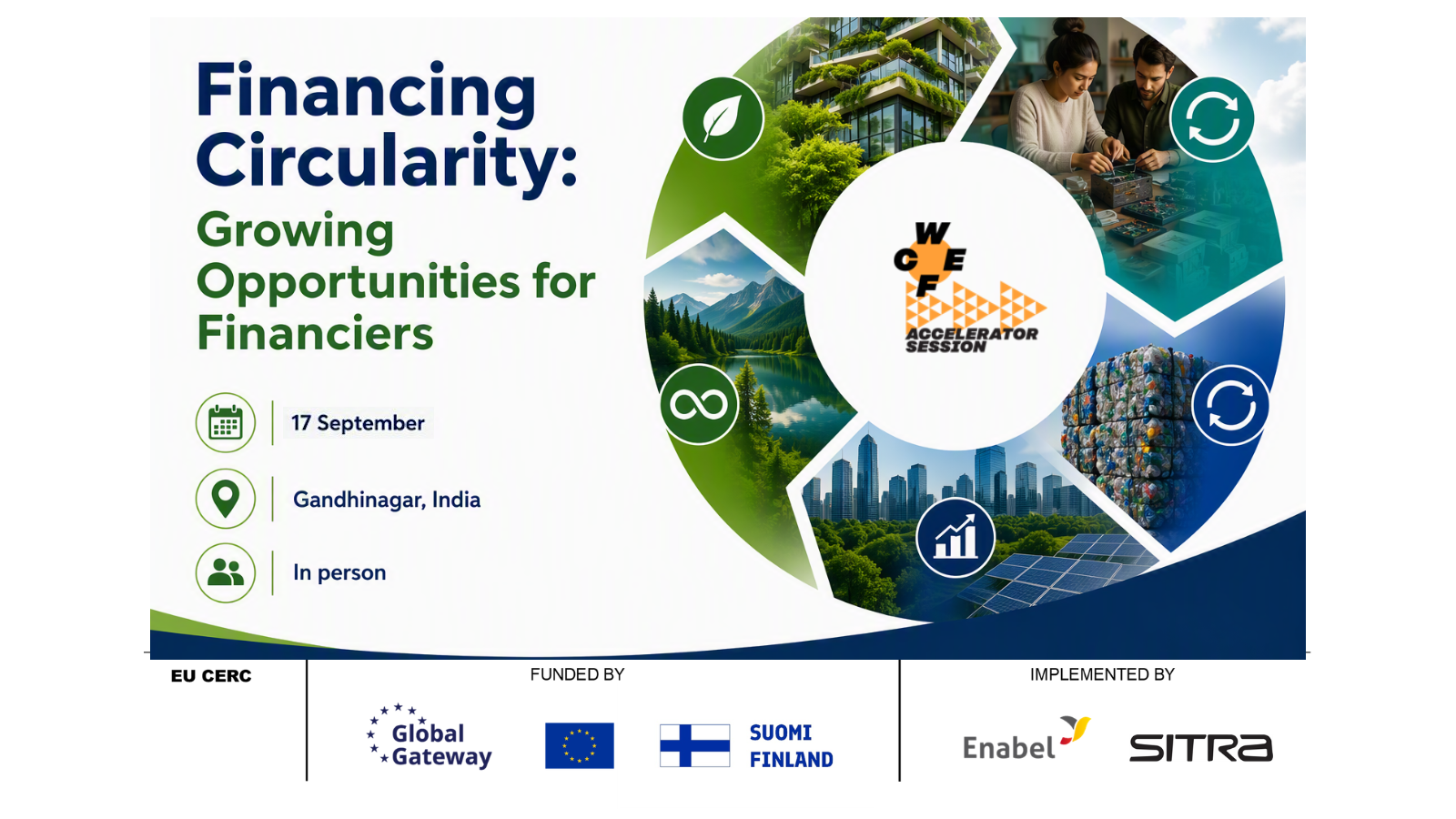
WCEF2026 accelerator session: Financing Circularity
Frederik VAN DEN BOSCH | 31/07/2026
Updated day/time: Thursday 17 September at 14.00hrs Financing Circularity: Growing Opportunities for Financiers Join us for this accelerator session organised in the framework of the World Circular Economy Forum in Gandhinagar, India. This 2-hour session will present challenges and opportunities financing the circular economy. It is organised by the EU Circular Economy Resource Centre (EU CERC). The session targets all financiers: development banks, commercial banks, fund managers and foundations and their clients. It is designed to be complementary to the other finance sessions. If you are a financier interested in a resilient future, we look forward to meeting you here! Finance is always mentioned as a necessary input for more circular business. We will share some of the experiences of different financiers, who are actively creating and reaping the opportunities that the circular economy offers, for Better Clients and Lower Risk. Come and listen to their strategies, their tools, their practices.Draft program 17 September 14.00-16.00hrs 14.00 registration and coffee 14.30 Opening, by Enabel Nicoletta FAVARETTO, introduction of schedule and speakers 14.40 Ovation Luisa SCHILLINGER will present a new publication and online knowledge product on Financial Mapping – the Opportunities of Circular Finance 15.00 Panel discussion, moderated by Enabel Frederik VAN DEN BOSCH, with different “voices from the field”: a bank (Yes Bank, name tbc), a fund manager (Sagana, Akash SINGH), and a foundation (Climate KIC, Eva ROS) who will present and discuss (i) great examples of circular practices, (ii) the potential for more circular financing and (ii) what they need from others to finance more circularity. Q&A last 10 min 15.55 closing (ending at 16.00) This session is an accelerator session at the World Circular Economy Forum 2026 www.wcef2026.com. WCEF2026 will gather forward-looking thinkers and doers and present the gamechangers in the circular economy. The forum will be held from 15 to 18 September 2026 in Gandhinagar, Gujarat, India. This session is organized by Enabel, the Belgian agency for international cooperation, as co-manager of the EU CERC. EU CERC is a five-year project funded by the European Union and the Ministry of Foreign Affairs of Finland, and implemented by the Sitra, Finnish Innovation Fund and Enabel. The Centre aims to increase the uptake of sound and inclusive circular economy policies and business models, based on peer-to-peer exchanges and partnerships between EU and partner’s country stakeholders. MORE INFORMATION AND REGISTRATION HERE: https://www.eventbrite.be/e/financing-circularity-growing-opportunities-for-financiers-tickets-1995933844859?aff=oddtdtcreator
-
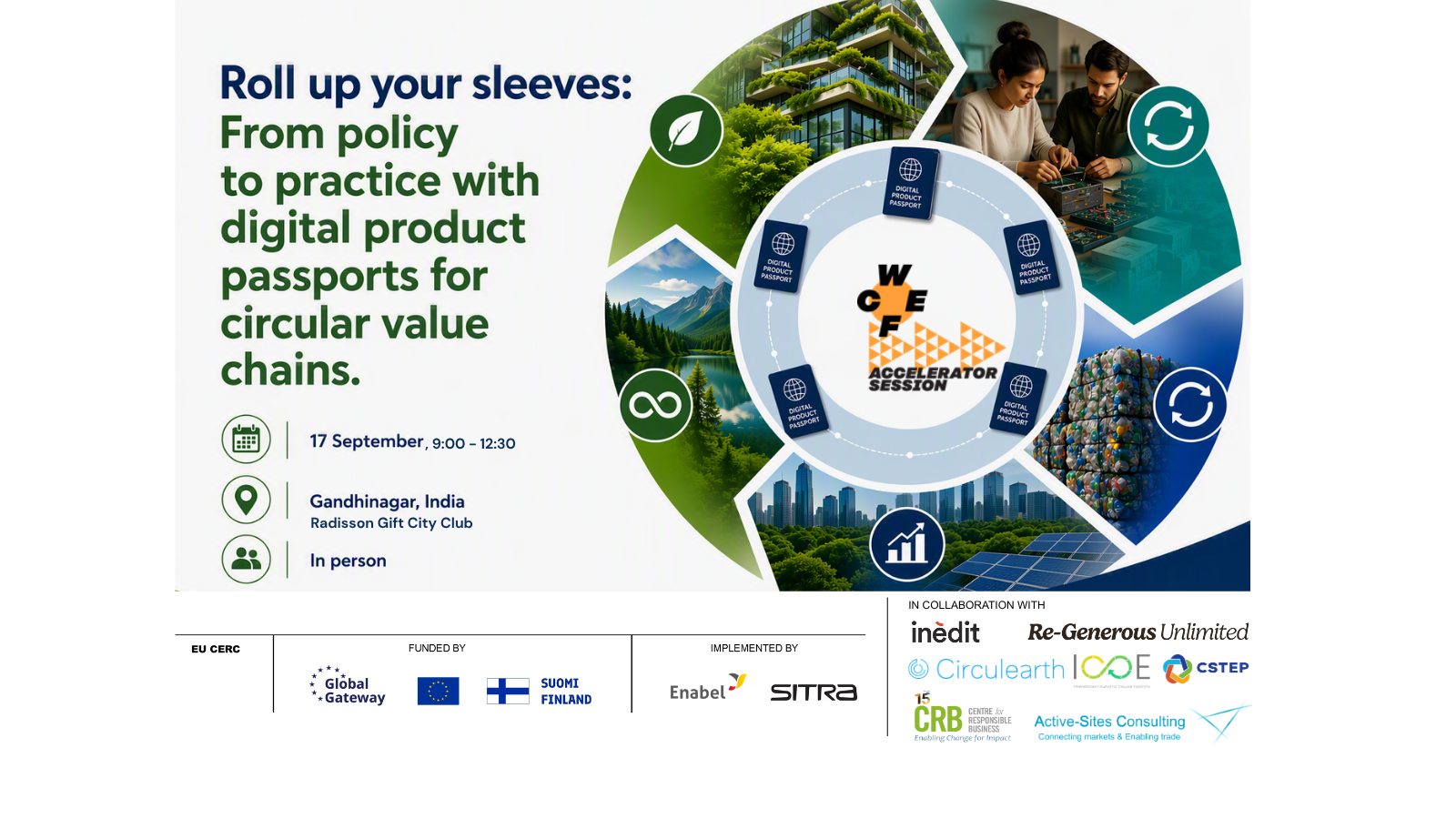
WCEF2026 accelerator session: From policy to practice with digital product passports for circular value chains
Nicoletta FAVARETTO | 31/07/2026
Roll up your sleeves: From policy to practice with digital product passports for circular value chainsJoin us for this accelerator session organised in the framework of the World Circular Economy Forum in Gandhinagar, India.This 3-hour accelerator session will help businesses, business support organisations and public authorities turn digital product passport (DPP) requirements into practical capabilities for ecodesign, circularity and resilient supply-chain collaboration. It will connect the EU regulatory trajectory with the realities of Indian MSMEs and other Global South suppliers, showing how structured product data can support decisions on materials, durability, repairability, environmental performance and circular business models.The programme follows a three-step approach, from policy context to implementation and participant readiness. It will introduce the evolving EU circular economy and DPP landscape, drawing on policy perspectives and experience with the EU Delegation in India; showcase a decentralised, data-sovereign DPP approach; and conclude with a hands-on workshop to identify data needs, stakeholder roles, governance requirements and practical next steps for implementation.The session is organised by Sitra, the Finnish Innovation Fund; Enabel, the Belgian Development Agency; inèdit and Re-Generous Unlimited in the framework of the EU Circular Economy Resource Centre project and by Circulearth; the International Council for Circular Economy; Active-Sites Consulting; the Centre for Responsible Business; and the Center for Study of Science, Technology and Policy.This session is an accelerator session at the World Circular Economy Forum 2026 www.wcef2026.com. WCEF2026 will gather forward-looking thinkers and doers and present the gamechangers in the circular economy. The forum will be held from 15 to 18 September 2026 in Gandhinagar, Gujarat, India.DRAFT PROGRAMME17 September 2026, 09:00 - 12:00Gandhinaghar, India at Radisson Hotel Gift ClubEvolving EU policy: drivers for data in circular economy 09:00-09:10 Opening remarks 09:10-09:25 Keynote address: Evolving EU circular economy and ecodesign policy09:25-09:40 Navigating the EU ESPR: Impact and readiness for Indian markets09:40-09:50 Participant activation exercise09:50-10:20 Panel discussion: Designing a systemic shift through sustainability data utilising EU policy as a lever to create local value10:20-10:30 Policy session closure + Q&A10:30-10:45 Coffee break Towards practice: Workshop on readiness for digital product passports 10:45- 10:55 Workshop introduction and toolkits for BSOs and MSMEs 10:55- 11:40 Breakout session: Digital Product Passport Readiness11:40- 11:50 Synthesis and next steps11:50- 12:00 Closing remarks12:00-12:30 Networking and voluntary speed diagnostic clinics MORE INFORMATION AND REGISTRATION HERE: https://www.eventbrite.be/e/from-policy-to-practice-with-dpps-for-circular-value-chains-tickets-1996...