How Families are Saving for Solar Irrigation in Mozambique
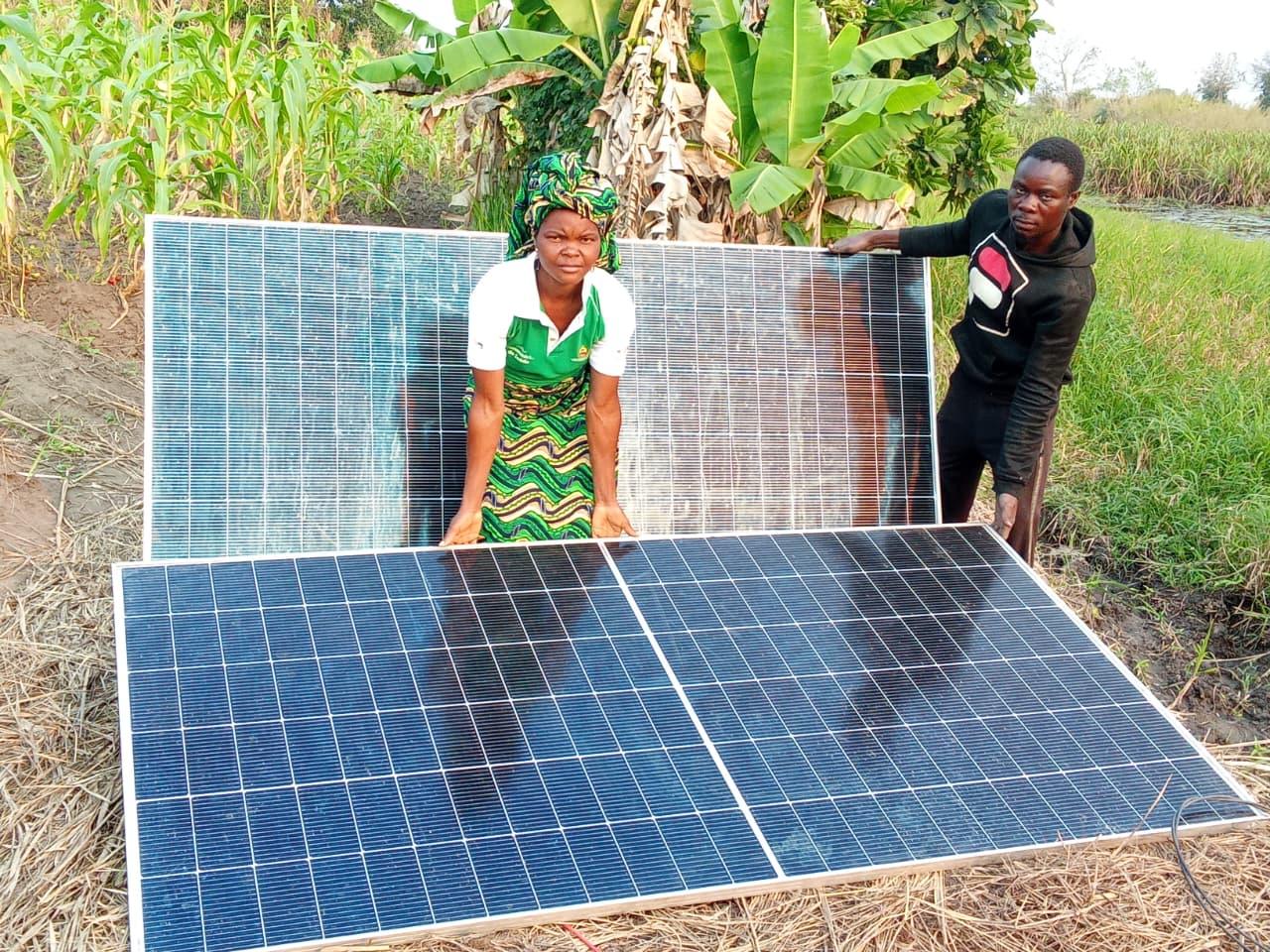
In Nicoadala, Derre and Mocuba, 15 couples of farmers spent two days earlier this year doing something most of them had never done before: writing down, line by line, where their money actually goes.
The exercise was part of a financial education training organised by Enabel's RERD2+ — the second phase of the Renewable Energy for Rural Development programme — in partnership with the National Institute or Irrigation (INIR). The goal was to prepare farmers who wanted to aquire a Solar-powered Irrigation System (SPIS) to cover their share of the cost. RERD2+ subsidises up to 80% of each system with the remaining 20% coming from the producer. For many, that down payment is the real barrier to adopting the technology.
The numbers behind the story
Among the participants was Chelton and his wife Tânia Raimundo, a couple of farmers from Nicoadala. As a practical exercise, they tracked every entry and exit of money in their household for seven days in a flipchart. “At first, I was eager to find out about my financial situation and was hopeful that everything would be fine. But as the calculations progressed, I realized things weren’t quite as good as I’d thought.” said Chelton. The balance? A negative 234 meticais. But the exercise did not stop there.
“When I saw the negative balance, I became extremely worried. I kept asking myself: How am I going to contribute 40,000 meticais toward the purchase of the irrigation kit? What will happen to my dream of opening my own agricultural supply store? How will I pay for my children's education? Will I even be able to start the next farming season? Then Engineer Mário Fijamo helped us identify expenses that were not essential. When I saw the balance turn positive, I felt enormous relief. My wife and I smiled, and so did everyone else in the room."
The couple's exercise quickly became more than an individual case study. As trainers worked through his household budget in front of the group, his numbers transformed an abstract financial concept into something tangible. His experience encouraged the other 14 couples to begin keeping their own household records to make better financial decisions for themselves and their businesses.
Budgeting beyond the household
The training also corrected a widely held assumption. At the start, almost every participant agreed that an expected future cost should be financed with a loan. By the end of the session, the group had reversed that view, understanding how predictable expenses should be covered by savings. It's a small shift in thinking, but it sits at the centre of why this training existed since a SPIS is exactly the kind of cost that needs to be planned and saved for, not borrowed against on short notice.As a direct result of the training, 10 out of the 15 couples trained planned to make their first deposit for the SPIS within two months, a concrete sign that the training achieved its main goal.
Chelton and Tânia not only managed to save up towards their first installment to acquire the SPIS, but a year later managed to register their business and obtain a license to operate the agriculture supply store. A goal they feared would only be a distant dream.
This training does more than preparing communities for investment. The skills behind it: tracking income and expenses, telling fixed costs apart from optional ones, matching the right expense to the right source of financing, don't expire once the SPIS is paid for. They're the same skills they will use to manage cash flow during a bad harvest, decide whether a new investment is affordable, or know in real time whether the irrigation system is paying for itself.
That's the difference between subsidising a piece of equipment and building a producer who can sustain one. The system arrives once, but the capacity to manage it has to be there for the life of the business.
Latest news from this project
No news