Clovice refuses to let disability define his future in Uganda
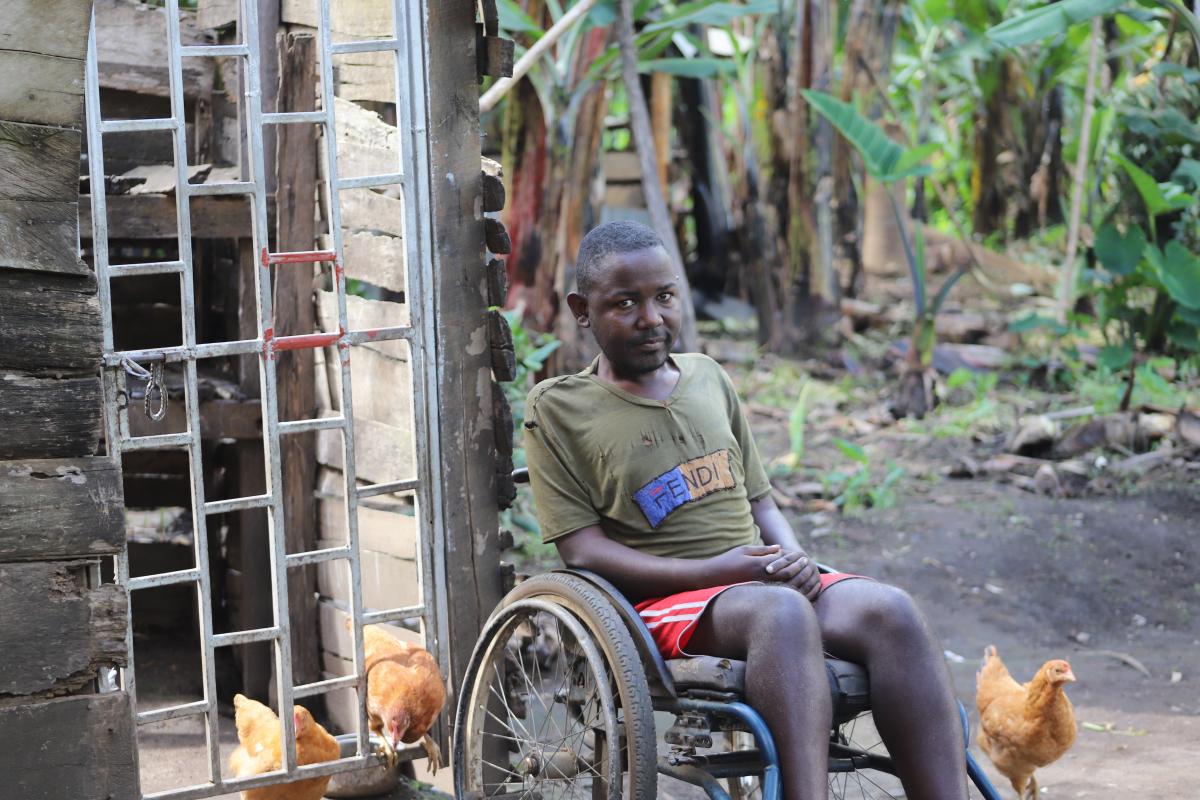
When Clovice Kyomuhendo
noticed that people in his neighbourhood travelled long distances to buy
chicken, he saw this as a business opportunity. He decided to start small,
considering his small savings.
In
2025, Clovice started small by buying six birds to rear at home. By the time of
this interview, his flock had grown to 27, and he was already making plans to
expand his poultry business further.
Clovice applied and
joined the WeWork – green and decent jobs for youth project after hearing about
it from The Association of Rwenzori Community (RCA). RCA, is an organsition
that works with Ille de Paix to implement this project in the Rwenzori
region, alongside Enabel.
By the time Clovice joined the project, he
had already begun his poultry business but recognized the need for additional
skills to improve it. Through the training, he gained knowledge in poultry
management, record keeping, and feed formulation techniques that help reduce
production costs.
"The training
took me to another level because of the knowledge I gained," he says.
Clovice is physically
disabled and uses a wheelchair, but that has not stopped him from running his
business. He works closely with family members who help with the physical tasks
while he manages the enterprise.
"I did not want
to feel sorry for myself because of my disability," he says. "I am a
man and I must fend for myself. Where I cannot manage alone, I ask for help
from my parents and relatives."
After
completing Primary Seven, Clovice was unable to continue with formal education
due to a spinal cord condition that left him paralysed. As he reflected on his
future, his parents enrolled him in a tailoring course, which he embraced
wholeheartedly. Today, he owns a special sewing machine designed for use
without legs, enabling him to work independently and pursue his craft. Beyond his own work, Clovice also trains other young people in
tailoring free of charge.
“I let them pay for my training services only after they start working and start earning income”,he explains.
As he makes money from
tailoring, his poultry business is continuing to grow. He currently sells birds
at between UGX 38,000 (€9) and UGX (€9.5) higher than before
because they are healthier and better managed. He also keeps detailed business
records and has written down a clear growth plan. By 2028, he hopes to have 500
birds.
He is also saving UGX
10,000 (€2) every week through a Village Savings and Loan Association
(VSLA), while using income from tailoring to expand his poultry enterprise. By
the time of this interview, Clovice had already requested 20 one-month-old
chicks and 70 kilogrammes of feeds as his start up kit.
According
to Lamark Muhindo, a project officer with RCA, every participant in the WeWork
project who completes the bootcamp and begins mentoring sessions receives a
start‑up kit tailored to their most immediate needs. The kit is provided in
kind and is valued at no more than UGX 500,000 (€120). Clovice chose to rear
dual‑purpose birds, which are well suited to his management system. “Because of
the breed, they can safely spend some time scavenging outside for food, which
helps reduce feeding costs,” Lamark explains.
For Clovice, the
business is about much more than selling chickens. He says that It is proof
that disability does not have to determine a person's future.
Latest news from this project
No news