From Blockchain to Local Brews: Inside Uganda’s ACPCU
The Ankole Coffee Producers Cooperative Union (ACPCU) sits at a curious crossroads: a union rooted in the hills of south-western Uganda, yet increasingly wired into blockchain ledgers, EU regulatory frameworks and NFC-enabled farmer cards. In a wide-ranging conversation with TDC, Derrick Komwangi, ACPCU's Projects Officer, spoke candidly about regulation, income, digitisation, youth and the union's ambitions for the next decade - and along the way, dismantled a few assumptions about what is actually keeping Ugandan coffee farmers up at night.
Navigating the European regulatory landscape
Much of the international conversation around African coffee exports currently centres on the EU Deforestation-free Regulation (EUDR). ACPCU, which sends the vast majority of its coffee to Europe, might be expected to be nervous. Komwangi is not. "EUDR is part of the growing regulations in the European Union, which is a major market for us, as about 90% of ACPCU's coffee goes to the EU region. A government programme, alongside assistance from the aBi and the European Union, helped map about 29% of our farmers," Derrick Komwangi said. His verdict on the regulation that has dominated headlines is blunt: "To be honest, EUDR is not as big a challenge as people portray it to be."
The real disruption, he argued, has come from elsewhere. "For us, the biggest challenge and impact came from the new EU organic regulation. Its impact was far-reaching and devastating compared to the EUDR." The sticking point is structural. "We have been lobbying against them, specifically regarding the legal entity requirements which conflict with the structure of cooperative unions. We hope this requirement will be reduced or reversed," Komwangi said.*
Sustaining a living income beyond market fluctuations
Ensuring a living income for farmers remains a core mission for ACPCU. Fortunately, current market dynamics are favourable. "The current price is far above the living income benchmark for Uganda, because the market has gone up," Komwangi explained.
This surge has proven that "the consumers can take the living income prices, and even far above that," which has led to a tangible impact on the ground. "We are seeing farmers take up new seedlings with limited or no subsidy," he observed, showcasing a renewed investment in farm production.
However, ACPCU is not relying solely on high market prices. "Living income is a destination with very many pathways towards it". To boost productivity, currently "about 40% below the optimum", the union is turning 1.5 million kilogrammes of organic coffee husks into fertiliser.
Other levers sit outside the farm gate entirely. "Since 57% of what affects the living income relates to off-farm factors like education and health, we are running a health insurance programme," Komwangi said. "In its first year, we already have about 900 paid doctor visits for our farmers, 62% of whom are women." The logic, he said, is straightforward: "This buffers their income from being expended on health shocks."
Digitising the value chain
Supported by a TDC grant, ACPCU is partnering with Fairfood to pioneer digital traceability, equipping farmers with Near Field Communication (NFC) cards. "The farmer will swipe their card against the phone in the cooperative's office and it will bring the details of this farmer," Komwangi detailed. This real-time data goes onto a blockchain, allowing the final consumer to "scan the code and know that this coffee came from this very farmer and that they were paid this amount".
Regarding data sovereignty, ACPCU relies on detailed consent forms, as only "about 17% of farmers have data" or smartphones. Komwangi emphasised that transparency is key to maintaining trust: "So long as farmers can see tangible benefits coming to them, they do not have a problem with providing such data. The trust is broken when all this information is requested... but the market does not want to give anything in return".
Cultivating a local market
Years ago, a coaching programme run under the TDC observed that ACPCU tended to lean on external partners rather than build its own marketing muscle. That has since changed dramatically, not least with the establishment of an in-house local marketing department.
"Our approach has changed significantly, and we have seen a very sharp rise in our local sales volume," Komwangi said. The scale of that shift is hard to miss: "We went from handling 500 kg to 6 tonnes this year, and our local monthly revenue grew from 500,000 to around 20 million shillings (around €4,639)."The ambition doesn't stop there.
"Our medium-term target is to sell one container locally," he said, framing why that single container matters so much: "One container sold locally is equivalent in value to four exported containers. If we can scale up to 10 containers locally over the next decade, that will equal the value of 40 exported containers, and that premium can be used to buffer the living income gap."
Uganda still has a long way to go compared with its regional neighbour. "Local coffee consumption in Uganda is currently below 5%, compared to 50% in Ethiopia, but it is increasing thanks to sales promotions and advertising supported by the grant," Komwangi said.
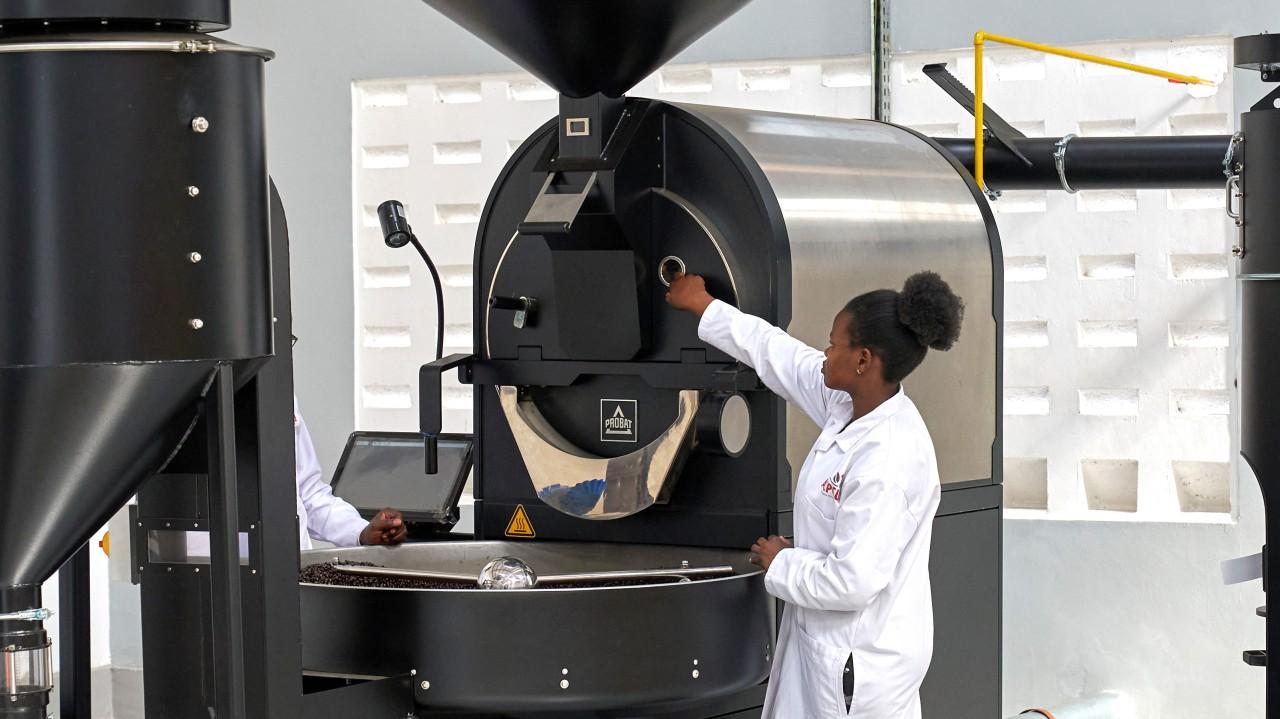
The TDC grant and a previous investment in the ACPCU’s roasting operations have enabled the organisation to refine its business model. "This ongoing support and our previous investment in the roastery have dramatically reduced our cost of production," he said. The union’s packaging strategy has also been reviewed: "Previously, we only sold coffee in units up to 500 grams to 1 kg. We have now downsized our packaging to 20-gram sachets sold for 1,000 shillings, which has become our cash cow, representing 80% of our local market sales." An even smaller format is on the way: "We plan to introduce a 10g single sachet."Training for a cooperative society.
Bringing young people back to coffee
ACPCU has lifted youth participation in its supply chain from 4.1% in 2020 to 13% in 2025, a shift Derrick Komwangi links directly to succession planning. "With our elderly farmers averaging around 56 years old, ensuring succession is vital," he said. "We want to make coffee farming a gainful, decent business rather than just an inherited chore."
Concrete incentives have driven the change. "To achieve this, all our cooperatives offered a 30% reduction on buying shares for young people, which led to a significant hike in youth engagement. We have also trained youth as service workers to support elderly farmers and bridge value chain gaps," Komwangi said.
Getting young Ugandans to actually drink the coffee they help produce is a separate battle. "We need the younger generation to consume the coffee. Since the local young population views coffee as a functional product for a caffeine boost rather than a lifestyle, we are targeting universities and local football clubs to shift behaviours," Komwangi said. The product range is set to evolve accordingly: "Over the next five years, we plan to explore iced coffee and cold brews to match their preferences."
A vision for 2031: science, innovation, and growth
Looking ahead to the 2026 - 2031 period, ACPCU has an ambitious vision to support "50,000 smallholder farmers" and process "500 containers". Product innovation is at the forefront, with a shift towards experimental processing, such as the "use of yeast, fermentation, inoculation" for honey-processed coffees, which provides a "more stable high quality" and a "bigger margin that we can play with to give back to the farmer".
Derrick Komwangi views this R&D push as a matter of long-term survival, likening the challenge to the foresight required for New York’s development in the 1800s. Just as city planners then had to build infrastructure for a future metropolis without knowing exactly how transport technology would evolve, ACPCU is investing in science and knowledge now to ensure the cooperative’s longevity. "If we do not invest in the knowledge," he reflects, "then we will not be here. We have already had the approval of the management and the Board to start a small science lab," Komwangi shared. This will allow them to conduct chemical residue tests locally rather than shipping expensive samples to Europe. Summing up the cooperative union’s forward-thinking philosophy, he concluded: "If we don't invest in knowledge, we won't be there... We must work on research, knowledge for the farmers themselves".
What emerges from the conversation is a cooperative treating regulation, data and youth engagement not as separate compliance boxes to tick, but as interlocking pieces of the same long-term strategy: keeping Ugandan coffee - and the farmers who grow it - competitive for decades to come.
Interview conducted by Samuel Poos, Project manager of Enabel’s Trade for Development Centre, on 27 June 2026.
* The regulation sometimes forces organisations to split artificially, with no more than 2,000 members per group permitted. For more information, read this TDC article: European organic regulation: progress and challenges for small producers in third countries.
Latest news from this project
No news