First Policy Dialogue on Active Labour Market Policies Convenes in Amman
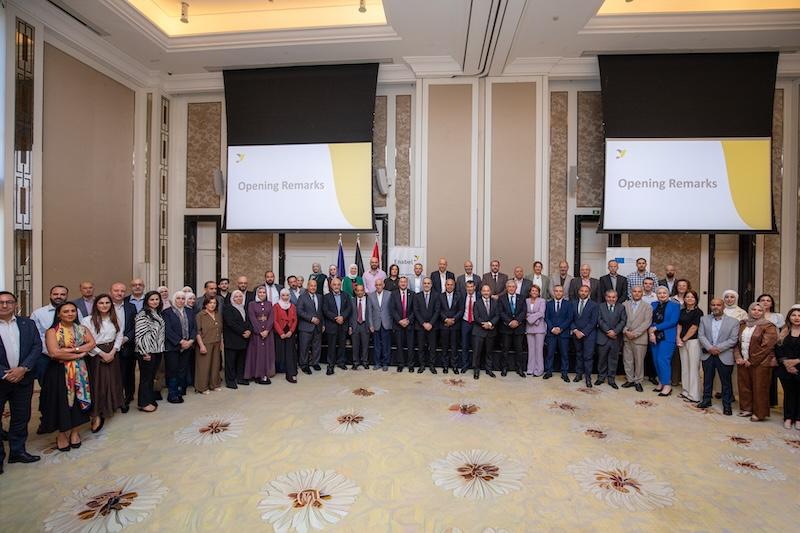
Under the patronage of the Ministry of Labour, Enabel—the Belgian agency for international cooperation—convened the first policy dialogue in a series on Active Labour Market Policies, bringing together key stakeholders to rethink employability in the face of growing economic uncertainty. Held under the European Union-funded Employment and Livelihood Programme (ELP), the dialogue—titled “Employability in an Age of Shocks”—aimed to reassess what “employability” means in a context shaped by economic volatility, regional instability, and increasingly non-linear labour market pathways.
Attended by the Minister of Transportation, acting Minister of Labour, H.E Dr. Nidal al Katameen, and H.E. Dr. Abdulhaleem Doghan, Secretary-General of the Ministry of Labour, the event opened with remarks by H.E. Mr. Pierre-Christophe Chatzisavas, Ambassador of the European Union to Jordan; H.E. Mr. Serge Dickschen, Ambassador of the Kingdom of Belgium to Jordan; and Ms. Heidi De Pauw, Country Director of Enabel in Jordan and Palestine. Speakers underscored the need for more adaptive, forward-looking approaches to skills development and employment policies.
H.E Mr. Chatzisavas said that “The European Union has placed skills in a life-long learning perspective and employability at the centre of its policy agenda, both internally and in its cooperation with partner countries such as Jordan. In a labour market facing growing pressure from regional instability, recurring economic shocks, and deep structural changes, training systems should equip young people with transferable skills, adaptability and the confidence to continue learning throughout their lives.”
Meanwhile, H.E Mr. Dickschen, added: “We’re proud that Belgium, through its development agency Enabel, and in close collaboration with our Jordanian partners, contributes in a meaningful way to the employability of Jordanians and Syrian refugees. Enabel’s rich experience in vocational training must help closing the gap between education and skills on the one hand and the demands of the labour market on the other hand.”
“Today’s labour markets no longer follow predictable paths. If we want to support young people effectively, we must shift from preparing them for a single job to equipping them with the skills, resilience, and adaptability needed to navigate constant change,” said Ms. Heidi de Pauw, Country Director of Enabel in Jordan and Palestine.
A central highlight of the dialogue was the strategic panel discussion “What Does ‘Job-Ready’ Mean When the Economy Is Not Stable?” Which explored how instability is reshaping employer expectations and challenging traditional education-to-employment models. Discussions highlighted a persistent mismatch between linear policy assumptions and a labour market increasingly defined by frequent transitions, short-term roles, and shifting career paths.Participants engaged in parallel breakout sessions under the theme “Redefining ‘Job-Ready’ in Unstable Labour Markets.”
These sessions examined how employers assess readiness under uncertainty and identified the skills and behaviors that enable individuals to remain employable across multiple transitions. Emphasis was placed on transferable skills, learning-to-learn capacities, and real-world exposure.Key insights were consolidated during a collective synthesis session, where participants identified shared priorities and policy-relevant messages. The dialogue concluded with agreement on the development of a Policy Insight Brief titled “Employability Under Uncertainty – Implications for Skills Systems in Jordan,” which will capture the outcomes and inform future policy discussions.
As the first in a series of four dialogues, this event marks an important step toward strengthening evidence-based policymaking and fostering collaboration to better align skills systems with the realities of a rapidly changing labour market.
Latest news from this project
No news